PEMF vs. Shockwave
By Jodi Alexander — PEMF Business & Equipment Advisor
One is a platform. The other is a precision instrument.
Here's how to know which one belongs in your practice — and why so many operators end up running both.
If you're weighing PEMF against shockwave — or wondering whether your practice needs both — here's the honest answer up front — they aren't the same kind of tool, so "better" depends on the practice you run and the clients you want to serve.
Let's break down where each one shines, and why the two so often work better together than apart.
— Side-by-Side —
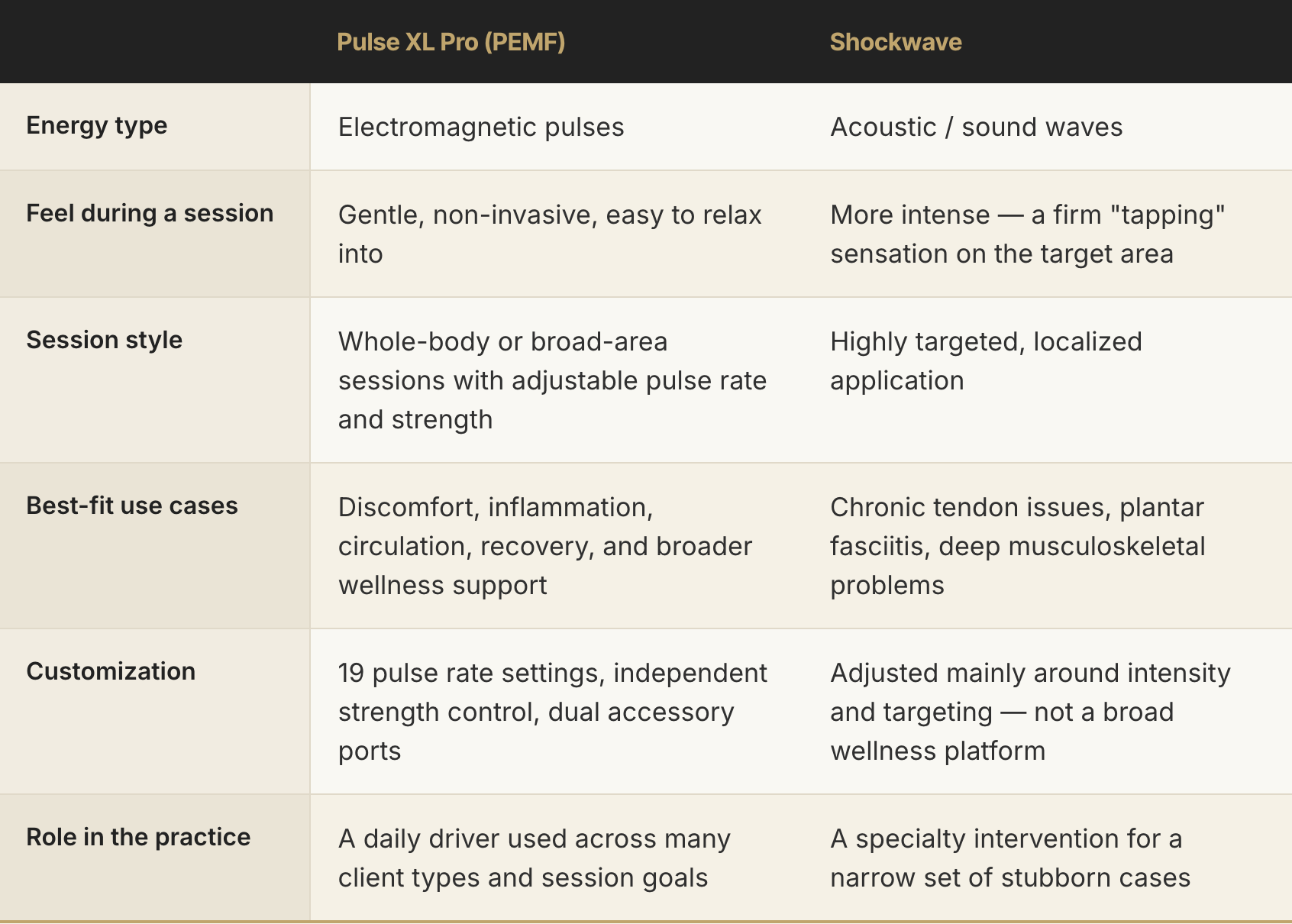
Before we get into strategy, here's the fast comparison — the differences that actually shape how each device fits into a working practice.
Where Shockwave Earns Its Keep
Shockwave is usually the better fit when the main problem is a specific structural issue — chronic tendon discomfort, plantar fasciitis, or calcified soft-tissue conditions.
Its strength is precision: it delivers a concentrated mechanical stimulus exactly where you want it. That makes it valuable in a clinic focused on orthopedic, sports rehab, or localized cases, and it can be a strong problem-solving modality when other approaches haven't moved the needle.
The trade-off is that shockwave is a specialist. It isn't a broad-session wellness platform, sessions are more intense for the client, and every minute of it requires a practitioner's hands and full attention.
Where the PEMF Machine Earns Its Keep
The PEMF I use wins on versatility, comfort, and repeatability.
Independent control of pulse rate and magnetic field strength, 19 pulse settings, and dual accessory ports make it easy to tailor sessions to different clients and goals.
It's non-invasive and generally far easier to tolerate than shockwave — which matters for client comfort, repeat visits, and broad adoption across your whole client base.
In plain terms: it can serve more people, more often, with less resistance. If your goal is a signature service clients actually look forward to and come back for, the XL Pro has the edge.
The Science: Why It Works at the Cellular Level
Here's what sets PEMF apart from a modality like shockwave: it doesn't just work on a spot — it works at the cellular level. Every process in the body, from movement to recovery to clear thinking, depends on cells having enough energy to do their job. That energy has a name: ATP.
Mitochondria: the cell's power plant
Inside nearly every cell in the body sit tiny structures called mitochondria — the power plants that convert oxygen and nutrients into ATP (adenosine triphosphate), the fuel your cells actually run on. When mitochondria are producing ATP efficiently, cells have the energy to function, communicate, and recover the way they're designed to. When ATP production drops off — from age, stress, poor circulation, or heavy demand — cells slow down, and so does everything they support.
How PEMF fits in
PEMF sends gentle electromagnetic pulses through the body that interact with the cell membrane and the charged particles moving across it. That interaction is associated with supporting the cell's natural electrical balance and encouraging more efficient mitochondrial activity.
The goal of a session is simple: help the cells do what they already know how to do — produce energy, exchange nutrients and waste, and stay in a state where recovery can happen — more optimally.
Why "whole-body" matters
This is the part that makes PEMF such a versatile platform. Because a Pulse XL Pro session delivers pulses across a broad area rather than one narrow point, it engages cells throughout the body at the same time — not just the muscle you're focused on. Better cellular energy isn't a local event; when cells across many systems are working closer to their potential, the client feels it as broader recovery, sustained energy, and an overall sense of running well.
Shockwave works a spot — PEMF works the cells, and the cells are everywhere.
The Bottom Line
Choose shockwave if your practice lives on plantar fasciitis, tendinopathy, calcified lesions, and other targeted orthopedic cases.
Choose the PEMF if you want a broadly marketable device supporting wellness, recovery, discomfort, and inflammation-focused sessions across a wider client base.
Choose the PEMF modality I have if you're building a business around client comfort, repeat sessions, and multi-use flexibility — then add shockwave later as a specialty upsell if your caseload calls for it.
It’s Simple —
Shockwave is the precision tool. PEMF is the platform tool.
Precision tools solve a narrow set of problems.
Platform tools create more revenue opportunities because they fit more visit types and more client needs — and that's the core reason the PEMF I invested in personally is so often the stronger practice investment.
Thinking about the right fit for your practice?
Let's talk through your client base, your space, and your numbers — and figure out which modality (or combination) actually moves your practice forward.
JodiAlexander.com · 406-696-7410 · jodialexander.csi@gmail.com